The Business of Independent Investment Banking Is Changing: What the Latest 2026 Data Tells Us

If you’ve been active in the lower middle-market M&A world this year, you’ve probably felt it already.
The phone is ringing more often. Buyers are engaging again. Investment banking pipelines are strengthening. Transactions that stalled in 2023 and 2024 are finally making it to the finish line.
But while the M&A market is clearly recovering, another trend is quietly reshaping the business of independent investment banking itself.
Recent industry research from Axial — including its 2026 M&A Fee Guide, Pursuits Report, Small Business Exits Report, and SMB M&A Pipeline — along with broader market reporting from Reuters, all point toward the same conclusion:
The firms most likely to benefit from the recovery aren’t necessarily the biggest firms. They’re the firms that have adapted their business models to today’s market.
Independent Investment Banking Fees Structures Continue to Evolve
One of the most interesting reports released this summer is Axial’s 2026 M&A Fee Guide, based on responses from 331 lower middle-market M&A advisors, investment bankers, and business brokers. The report offers one of the clearest looks available at how advisory firms are pricing engagements today.
Some of the most notable findings include:
Nearly one-third of advisors now charge no upfront engagement fee at all, up from just 19% in 2024.
Monthly retainers have remained relatively stable.
Success fees have remained remarkably resilient despite several challenging years for dealmaking.
Lehman-style fee structures remain the dominant model, although flat-percentage success fees continue gaining popularity.
Most advisors now credit engagement fees toward the ultimate success fee, further aligning incentives with clients.

For business owners, this trend can make hiring an advisor more attractive. Paying less upfront lowers the perceived risk of beginning a sale process.
For advisors, however, it’s a very different story. Moving toward success-fee-only engagements means taking on significantly more financial risk. Firms may spend months marketing a business, coordinating diligence, managing negotiations, and navigating unexpected delays — all without collecting meaningful revenue until closing. That shifts enormous importance toward:
Managing cash flow
Operating efficiently
Maintaining lean overhead
Having compliance infrastructure that doesn’t consume unnecessary resources
That said, engagement fees are still the norm, not the exception. 71% of advisors charge some form of upfront fee, most commonly a monthly retainer or a one-time fixed engagement fee.
Buyers Are Back — But They’re More Selective Than Ever
Another standout publication this year is Axial’s 1H 2026 Pursuits Report.
Unlike traditional surveys, the report analyzes actual buyer behavior across thousands of live lower middle-market opportunities marketed through the Axial platform. Rather than asking buyers what they intend to do, it measures what they’re actually pursuing.
Among the trends examined:
Industries generating the highest buyer interest
EBITDA ranges receiving the strongest engagement
Geographic demand
Buyer pursuit rates
How different buyer types respond to opportunities
One particularly interesting takeaway is that total buyer activity has increased—but buyers are becoming increasingly disciplined about where they spend their time. For example, Industrials generated the highest average buyer interest, while several smaller sectors produced exceptionally high pursuit rates relative to the number of buyers invited.
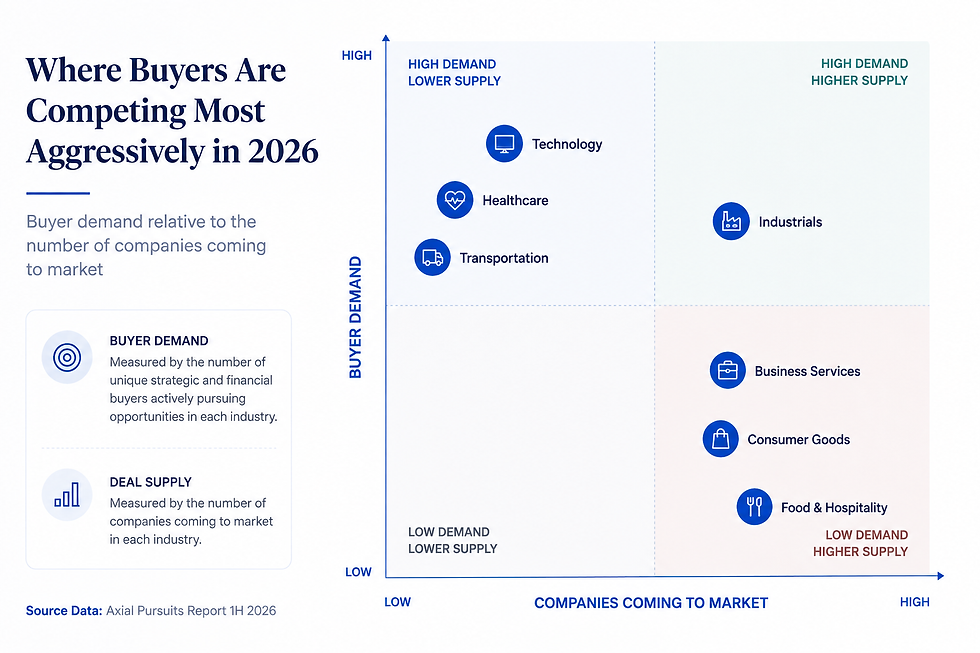
In other words: The buyers are there. They’re simply becoming more selective.
For independent investment bankers, that reinforces something experienced deal professionals have always known: Success isn’t driven by having the biggest buyer database. It’s driven by: knowing which buyers are active, understanding what they’re currently seeking, maintaining long-term relationships, and positioning opportunities appropriately before launching a process.
Deal Volume Is Growing Again
Axial also recently released SMB M&A Pipeline: Q2 2026, which provides another encouraging data point. According to the report:
3,523 companies came to market during Q2 2026, representing the highest quarterly deal volume ever recorded on the Axial platform, and approximately a 4.8% increase over the same quarter last year.
Technology recorded the strongest year-over-year increase, with a 23.52% increase compared to Q2 2025. And for the fourth consecutive quarter, Industrials ranked 1st in both deal volume and buyer pursuit rate — with supply and demand relatively aligned there. Transportation showed the largest gap between supply and demand, ranking 7th in deal volume but 2nd in pursuit rate.

Closed Deals Tell a Different Story Than Headlines
It’s easy to become distracted by billion-dollar acquisitions reported in the financial press. But most independent investment bankers operate in the lower middle market, where transaction dynamics look very different. That’s why Axial’s Small Business Exits Report, analyzing 265 completed lower middle-market transactions, is particularly valuable.
Rather than focusing on announced deals, the report examines transactions that actually closed, including valuation multiples, transaction structures, close rates, deal timing, buyer types, and industry-specific trends. Completed transactions often provide much better guidance than headline announcements because they reflect today’s financing environment, buyer expectations, diligence realities, and valuation discipline. For advisors serving founder-owned businesses, these are often the benchmarks that matter most.
Here are just some of Axial's closed-deal stats to come out of Q2:


Read the full Axial article for Q2 2026 here, and follow them for quarterly updates.
The Broader Investment Banking Market Is Recovering
The recovery isn’t limited to lower middle-market transactions. Reuters recently reported several encouraging developments across the broader investment banking industry, including:
Global investment banking fees at the 6 largest banks were up approximately 45% year-over-year in Q2 2026.
Global M&A activity surpassed $3 trillion year-to-date in 2026.
Goldman Sachs reported its highest advisory backlog in five years and its second-highest backlog on record.
Morgan Stanley reported projections of $6.4 trillion in global M&A for 2026 and announced its deals were up 64% in Q2 versus the prior year — driven by strong momentum in software, utilities, energy, and healthcare.
After several years defined by higher interest rates, valuation uncertainty, financing challenges, and slower transaction activity, meaningful momentum appears to be returning.
Read more here:
Why Independent Advisors May Actually Be Better Positioned
One interesting implication of all these reports is that today’s environment may actually favor experienced independent advisors. Business owners increasingly value:
Senior-level attention
Specialized industry expertise
Direct access to decision makers
Flexible engagement structures
Advisors whose incentives are closely aligned with successful outcomes
Large institutions certainly have advantages, but many founder-owned businesses prefer working with experienced advisors who personally lead every aspect of the transaction rather than delegating significant portions of the process to junior teams.
As more firms shift toward contingent compensation, efficiency also becomes a competitive advantage. Advisors who can keep compliance costs and review timelines reasonable, avoid unnecessary bureaucracy, and spend more time originating and executing transactions may find themselves better positioned than firms carrying heavier operational overhead.
If you're looking for experienced compliance support with practical transaction guidance, operational efficiency, flexibility, and a structure designed specifically for transaction professionals — Britehorn Securities may be perfect for you. Reach out to start a conversation today!



Comments